
Lutron vs Crestron for Architectural Lighting Control
As authorized designers for both Lutron and Crestron, we work with both platforms on luxury residential projects. Both are excellent. The question is never “which is better.” The right question is: which is the right specification for this house, in this project, with this design team?
This post is written for architects, interior designers, and luxury custom builders deciding how to brief the lighting and controls early in the project.
The Three Systems in Play
Lutron RadioRA 3
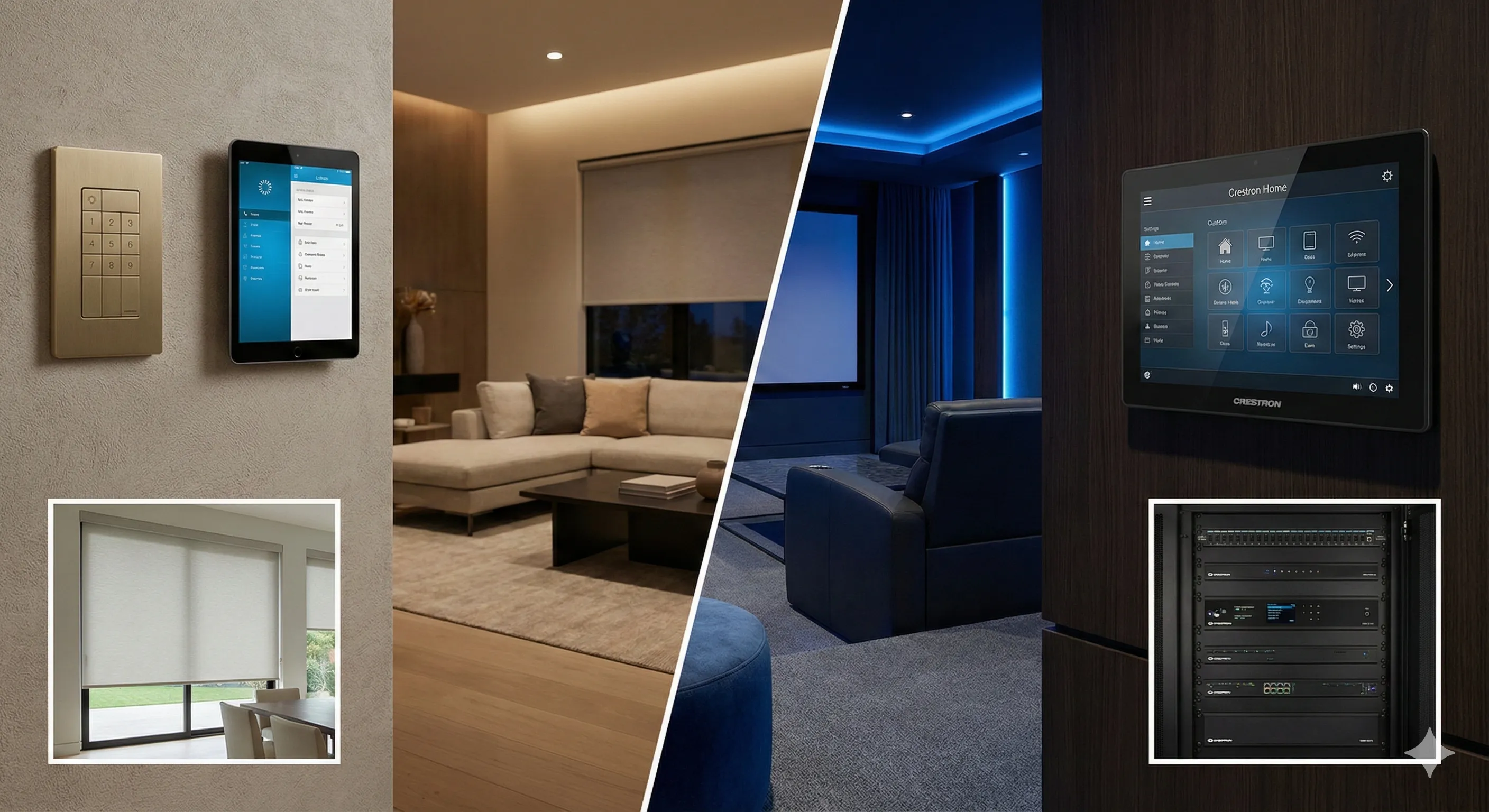
A wireless processor-based system. RF mesh between devices. Excellent retrofit posture and excellent for residences where pulling additional wire after framing would be intrusive. Strong keypad design with engraving and finish options. Pairs cleanly with Lutron motorized shades.
Lutron HomeWorks
Lutron’s wired flagship. Dimming and switching panels live in a centralized rack; high-density device counts; deeper customization; the right architecture for large estates and complex projects. The HomeWorks keypad line is one of the most refined in the residential market.
Crestron Home
Crestron’s modern residential platform, designed around a simpler programming experience than Crestron’s older custom-programming model. Tightest integration with whole-home AV, distributed audio, and Crestron’s own automation ecosystem. The right choice when the lighting control is part of a larger Crestron infrastructure already specified for the project.
How We Decide on a Project
Three questions, in this order:
1. What is the project’s existing infrastructure?
If the AV integrator has already specified Crestron for distributed audio, media, and motorization, Crestron Home is usually the right lighting choice — the integration is tighter and the household has one app rather than two.
2. What is the architectural condition?
Wired centralized panels (HomeWorks, Crestron) require space — typically a dedicated low-voltage room or a wall section in a utility space — and a documented panel-and-conduit strategy from schematic design. If that space exists in the architecture, the wired systems are usually the better specification. If the architecture cannot accommodate it cleanly, RadioRA 3 is often the right call.
3. What is the keypad and scene density?
Larger residences with many zones and many keypads benefit from the wired centralized architectures (HomeWorks, Crestron) for reliability and serviceability at scale. Smaller-footprint luxury residences are often better served by RadioRA 3.
The Aesthetic Question
Keypad design matters more than most people give it credit for. The keypad is the most-touched piece of “design” in the house — door hardware aside — and the lineup, finish, and engraving will be read by the household every day for fifteen years.
Lutron’s HomeWorks Palladiom and Alisse lines, and RadioRA 3’s keypads, are some of the most architecturally restrained controls available. Crestron’s Horizon line is similarly capable. The choice between them is a finish-coordination question to work through with the interior designer rather than a winner-takes-all.
What We Look For in Brief
| Project Condition | Likely Right Specification |
|---|---|
| Existing Crestron AV / audio / motorization | Crestron Home |
| Large estate with dedicated low-voltage room | Lutron HomeWorks or Crestron |
| Luxury residence with no existing AV infrastructure | RadioRA 3 |
| Retrofit or significant renovation, limited wire-pulling capacity | RadioRA 3 |
| Wellness / tunable-white scenes a priority | Any — depends on fixtures |
| Tight keypad-finish coordination with interior designer | Palladiom or HomeWorks Alisse |
These are tendencies, not rules. The right answer comes out of the project brief.
What This Is Not About
A few framings we deliberately avoid:
- It’s not about which platform is “smarter.” Both platforms handle the residential lighting scenarios our clients actually need.
- It’s not about cost per zone in isolation. A correctly scoped Lutron system can cost more than a poorly scoped Crestron system, and vice versa. The right comparison is between properly specified systems against the same brief.
- It’s not about app features. The household will press keypads. The app is a backup. Designing the control system around the app is designing for the wrong primary interaction.
How to Brief This Early
In schematic or early design-development, we ask the architectural team:
- Is there an AV integrator already on the project? If yes, what platform have they specified?
- Is there a planned low-voltage / equipment room in the architecture?
- What is the approximate keypad count and zone count?
- Are tunable-white fixtures and circadian behavior in scope?
- What is the interior designer’s posture on visible hardware?
The answers usually point clearly to one of the three platforms. We document the decision in the lighting design intent so the entire design team is working from the same specification by the end of design-development.
Working With Us on Controls
We are authorized designers for both Lutron and Crestron. We are platform-agnostic on principle and project-specific in practice. We specify the system that is right for the residence, document the design, and program the scenes in the finished house with the household, the architect, and the interior designer present. See Lighting Control for the full service scope.
Related reading
- Bring in a Lighting Studio Early
- The Lighting Design Checklist for Residential Architects
- Circadian Lighting in Luxury Residences
- Motorized Shades for Luxury Residences
Start a conversation → · info@c4light.com · +1 (917) 546-7400