
Motorized Shades for Luxury Residences: A Climate-Aware Guide
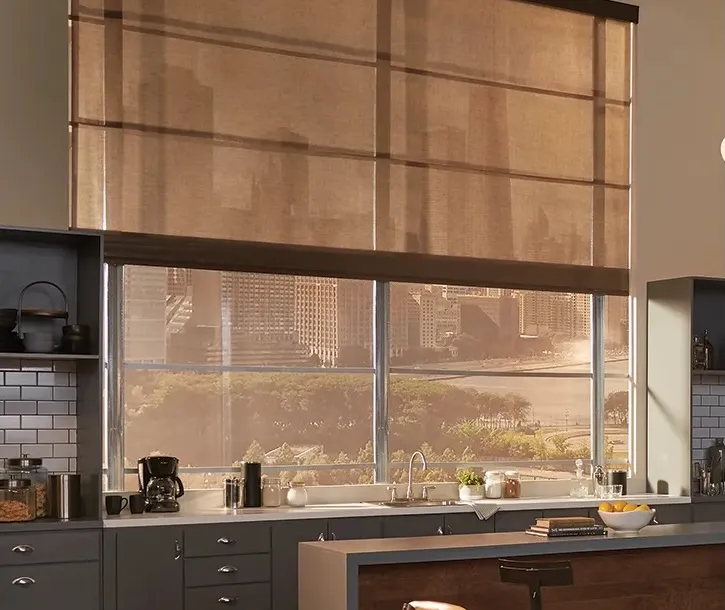
Motorized shades are the daytime half of the lighting design. They manage daylight, glare, solar heat gain, and privacy, and they belong in the same scenes as the lighting — running quietly in the background rather than asking the household to manage them. Specified well, they make the architecture better. Specified badly, they sit in pockets that were never framed.
This is a working guide for architects, interior designers, and builders on luxury residential projects.
Why Motorized Shades Belong in the Lighting Conversation
Daylight and glare. Glazing brings the long view, but glazing without a shade strategy brings glare on screens, on art, and on stone or glossy finishes. Shades modulate the daylight so the architecture reads cleanly at every hour.
Solar heat gain. Solar gain through glass is roughly five times the rate through walls. In Texas summers, in Florida summers, on south- and west-facing Tennessee glass: an unshaded west elevation can add meaningfully to the cooling load. Solar-filtering fabrics on motorized shades reduce that gain while preserving the view.
Privacy. Bedrooms and bathrooms need privacy at specific moments rather than all the time. Motorized shades make that an everyday-easy operation rather than a chore.
Scene integration. The shades belong in the lighting scenes. A “morning” scene raises the bedroom shades and lifts the lighting gently. An “afternoon” scene lowers the west-facing solar screens before the glare arrives. A “movie” scene closes the blackout layer and dims the lighting. The integration is the point.
Quiet aesthetics. Motorized hardware eliminates chains, wands, and the visible operational hardware of manual shades. The head detail is clean.
Climate Considerations Across Markets
Texas — Austin and the Hill Country. West-facing glazing carries the heaviest load. Solar-filtering exterior screens or interior solar shades on the west and south sides are the highest priority. Blackout shades in bedrooms are essential because summer mornings are bright at 5:30 a.m.
Florida — Naples and the Gulf Coast. The low Gulf sun, salt exposure, and lanai conditions drive the specification. Outdoor-rated solar screens on lanais are essential. Drapery on motorized tracks is common in the principal living spaces. Hardware specification matters more here than anywhere else.
Tennessee — Nashville and Middle Tennessee. Less aggressive than Texas or Florida heat, but with strong seasonal variation. South- and west-facing glass on hillside sites needs solar control. Bedrooms still want full blackout. Drapery is often part of the interior designer’s palette.
General principle. The shade strategy is a daylight-and-privacy decision, not a temperature decision. Treat it that way and the heat-load benefits come along.
Integration Timeline
Schematic Design. Identify which glazing receives shade control. Decide motorized versus manual at the zone level. Note shade pockets on the architectural set so they are visible to structural and to the framer.
Design Development. Confirm pocket dimensions and head details with the architect. Confirm fabric, color, and pattern with the interior designer. Specify the control platform (Lutron, Crestron) and integrate into the lighting control plan.
Construction Documents. Frame pockets during rough framing. Run control wiring and motor power as part of the electrical set. Specify the shade manufacturer with full SKUs, fabric numbers, and lift mechanisms.
Construction. Pockets are framed at rough-in. Wiring runs during electrical rough-in. Shades themselves are installed near the end of construction to avoid damage during finish work.
Commissioning. Programming, scene integration, and final calibration are done with the household and the design team in the finished house.
The total schedule impact, if the shades are in the design from the start, is essentially nothing. If they are retrofitted after framing, expect three to four weeks of rework and a multiple of the cost.
Specification by Type
Solar-filtering roller shades. For principal living spaces where the view should be preserved during the day. Filter 50–95% of solar heat. Specify openness factor against view requirement: 3% openness preserves more of the view at the cost of more heat, 1% openness blocks more heat at the cost of view.
Blackout roller shades. For bedrooms, media rooms, and guest suites. Specify with side channels and bottom seals if true room-darkening is required (no light leak at edges).
Dual-track configurations. Solar-filtering shade in front, blackout behind. The right choice for principal bedrooms — daytime view-and-privacy, nighttime full blackout. Two motors per opening.
Roman shades. Where the fabric is part of the interior design and the language is softer than a roller. Tailored, lined, weighted hems. Coordination with the interior designer’s drapery palette.
Drapery on motorized tracks. For luxury principal spaces. Often part of a layered system with shades on the same opening. Track engineering matters — quiet motors, smooth glide, accurate stop positions.
Outdoor-rated solar screens. For lanais, porches, pergolas, and exposed glazing in coastal or southern climates. Specified for full weather exposure and salt where relevant.
Retractable insect screens. A quiet adjacent specification on covered outdoor spaces, increasingly common on luxury work.
Priority Zones
Always motorize. South- and west-facing principal glazing. Primary bedrooms. Media rooms.
Strongly consider. Home offices (glare on screens, privacy on video calls). Dining rooms (entertaining flexibility). Bathrooms with significant glazing.
Probably manual is fine. North-facing glazing in residential areas. Small windows. Closets and laundry rooms.
Control Integration
Shades belong in the same control system as the lighting. Specifying them separately, on a different app or a different keypad, defeats most of the value. Lutron RadioRA 3 and HomeWorks both have native shade integration. Crestron Home does as well. The right choice depends on the broader control specification — see our Lutron vs Crestron post.
Common Failure Modes
- Pockets not framed during construction — the retrofit costs roughly ten times what the pocket itself would have cost
- Control wiring not run during rough-in — automation cannot be added later without wall work
- Fabric specified without the interior designer — clashes with the finish palette
- Shades installed too early — damaged during drywall, paint, or trim
- No programming time before move-in — the household never learns the system
Working With Us on Shades
We specify and project-manage motorized shades alongside the lighting design. See Motorized Shades for the full service scope, or Lighting Control for how the shades sit inside the Lutron or Crestron scene system. Installation is handled by trusted regional partners. We stay on the project through commissioning so the shades are calibrated to the actual finished space.
Related reading
- Lutron vs Crestron for Architectural Lighting Control
- Bring in a Lighting Studio Early
- The Lighting Design Checklist for Residential Architects
Start a conversation → · info@c4light.com · +1 (917) 546-7400